An extensive argument for Memory: From Plato's Innate Ideas to Rumelhart's Networks
Every era contrives a novel metaphor for the mind (automaton, switchboard, hydraulic systems, sentient webs), and then spends another century posturing the metaphor as Truth..

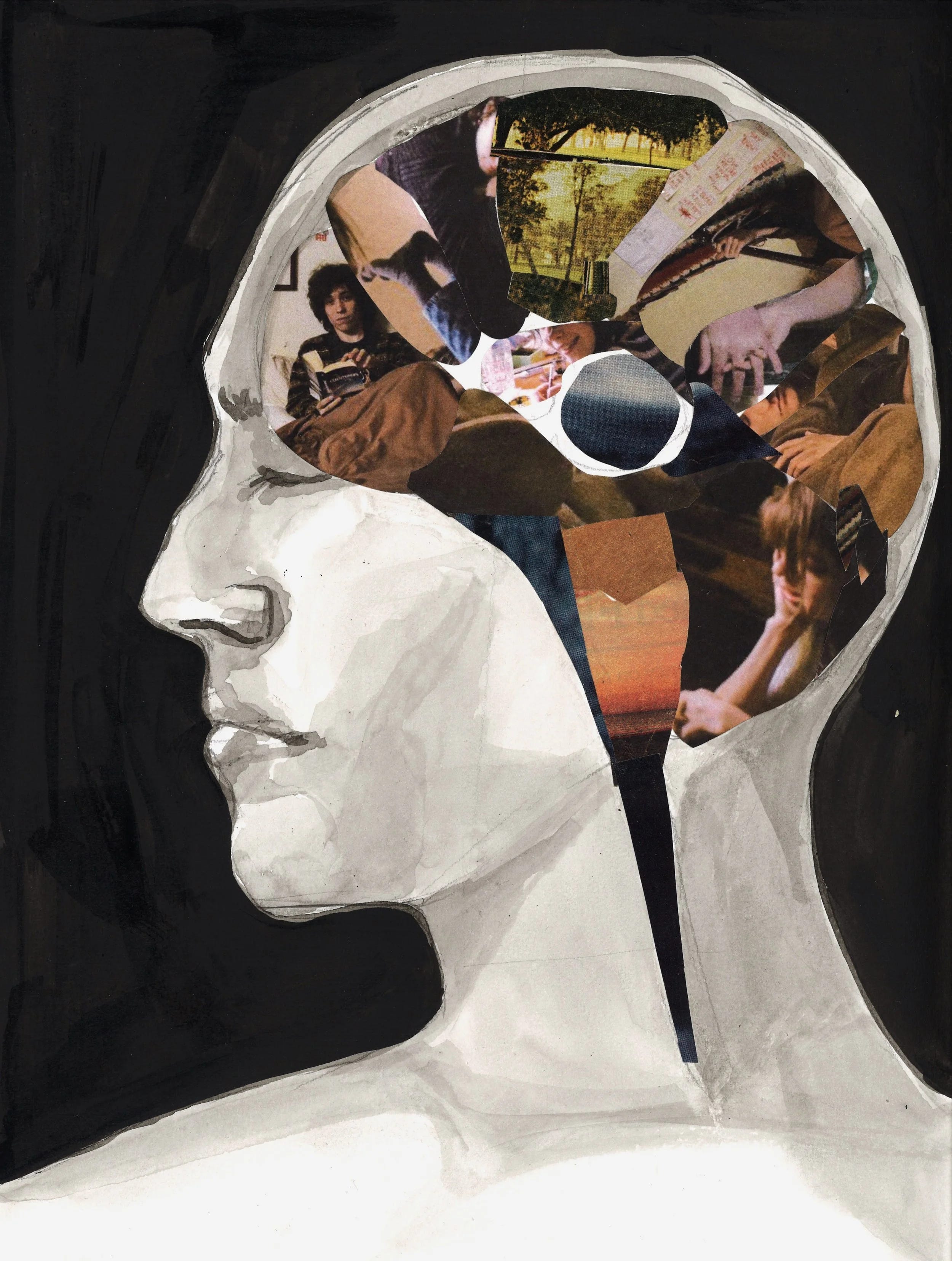
^Illustrations by Anna Bishop
Only dubiety amidst stochastic essence of cognitive experiences led Plato to epistemically engage with his own theories of learning and although he deemed experience itself as not the origin of our deepest knowledge, he posited it to a conceptual innate ‘virtue’. While in Plato’s Meno he seems to be emphasizing priors or constraints on mind’s structure as per this theory of recollection or anamnesis for inquiry to work, I seem to like the alignment between his and his successor’s ideas. Aristotelian metaphysics, even though in this context pulls an anti-Meno move by conflicting with the origin of knowledge whilst aligning just at the level of form and intelligibility, paves the way for modern-day compromise which posits that while one might be born with an innate learning system with built-in constraints, you’ll still fill in your database through experience. Now it is easily feasible how these early philosophers and their debates eventually get tiring, with later even Kant paraphrasing these ideas in his Critique of Pure Reason (A1/B1 passage). It seems that all the philosophical arguments around knowledge’s origins and conditions just shifts to a psychophysical quantification of how memory behaves. So, this triangle of ideas (i.e., Plato→Aristotle→Kant) basically transforms itself experimentally, with the genesis of psychophysics as a scientific discipline, into attempts to translate “mind” into mathematical functions to quantify measurable behavior.
With Fechner measuring mind-world relations via his establishment of experimental procedures for gauging sensation to Ebbinghaus measuring memory with curves via his inquiry into psychophysics of memory. I think Fechner’s project of quantification between physical stimulus and psychological magnitude via numbers was essentially applied by Ebbinghaus onto memory, wherein it becomes a function as opposed to a metaphor. Basically, he carefully engineers an experimental design, and after execution of the task begins to plot retention and forgetting as curves over trials and time, hence positing memory as a function. It might be safe to say then that in conjunction, while Fechner’s ideal is that inner life submits to the graph, Ebbinghaus’s questions like, “how fast traces fade?→ how spacing rescues them?→how interference bends them?” makes psychophysics of memory a more complete and rationally sound framework.
After theorizing and making connections that foster my understanding for a while via first-principles thinking (sort of.. as one can only read so much :p), I landed on an interesting conjecture i.e., that perhaps Rumelhart’s connectionism reverses the ontology of memory itself i.e., memory isn’t just a set of philosophical propositions and measured behavior, rather its also a dynamical system operating within distributed representations and its corresponding connection weights. This is where these ideas become relevant today, at least computationally speaking. Josselyn & Tonegawa (2020) contemporary research makes this synthesis quite literal by providing a necessary biological backbone via Engram evidence (i.e., a distributed neural-synapse trace). This implies that Rumelhart’s idea of distributed memory is in alignment with modern Engram neuroscience, wherein memory simply constitutes of distributed neurons and synaptic changes i.e., same idea, different level of application: model→brain tissue.
Essentially, the metaphor and paradigms change, yet the essence always remains. I think it will be fascinating to witness for future generation how this evolves, I personally sometimes cannot stop thinking about what happens post this cybernetic era.. what does memory then become?
-Sanj|27.01.2026